| |
|
|
Short-Time Work
|

|
|
The German Answer to the Economic Crisis |
 PDF Download
The reaction of the German labor market
to the worst global recession in postwar
history was relatively mild. It has
so far not translated into a significant
employment decline. Quite the contrary,
the size of the German working population
remained at a record level of more
than 40 million people through both
2008 and 2009. Short-time work certainly
made a substantial contribution
to this astonishing development. The
instrument helped significantly to cushion
layoffs by extending subsidies for a
temporary reduction in working hours.
A recent study by IZA Director Klaus F.
Zimmermann, IZA Research Associate Ulf
Rinne and Karl Brenke (DIW Berlin) analyzes
how short-time work has developed
and where in the economy it is
especially common, in particular
during the latest economic
crisis. Short-time work was, and
is, especially common in Germany’s
industrial sectors which
rely heavily on exports as well
as those service sectors closely
linked to industrial production.
At the end of 2009 one in
six employees with jobs subject
to social security contributions
and employed in machine construction
and metal production
worked reduced hours; in the
automobile industry it was one
in seven. As the number of short-time
workers declines, the proportion
of those who had long
since had their regular working
hours reduced is growing. Therefore, the
indications are that a base of long-term
short-time workers is developing.
A look back in history
The origins of a specified payment made
to employees in the case of short-time
work can be dated to the beginning of the
last century. The precursor was a law on
amendments to tobacco tax in 1909, as
a rise in tolls and taxes would mean less
work in the tobacco processing plants.
After World War I, short-time work was
integrated into the newly created unemployment
benefit scheme in all sectors
of the industry. Short-time work was deployed
on a massive scale during the f irst
economic crisis of the Weimar Republic.
By the time the world economic crisis
peaked in 1932, the share of short-time
workers had increased to more than
20 percent.
|
|

Regulations governing short-time
work during the time of the Weimar
Republic were broadly adopted by the
Federal Republic. Short-time work was
again deployed on a large scale in the
second half of the 1960s, which witnessed
the first post-war economic
crisis. After little over a year, however,
short-time work had once again
disappeared and unemployment had
greatly declined. Another vigorous rise
in short-time work in the middle of the
1970s and the first half of the 1980s
resulted from the oil and energy crises.
German reunification presented a
special case. Following the monetary,
economic and social union, production
in the former German Democratic
Republic collapsed at lightning
speed, and underemployment drastically
increased. Initially, the response
was predominantly the deployment of
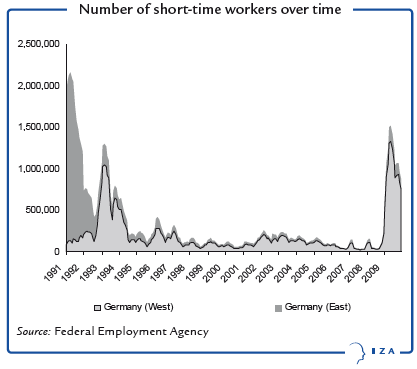
short-time work. In the
beginning of 1991, more than a quarter
of all employees in East Germany were in
short-time work. The reduction in working
hours was often as much as 100 percent.
On the one hand, the wish was to
retain the workforce because it frequently
represented the intrinsic essence of the
firms, with a view to privatization; on the
other hand, the soaring rise in unemployment
was supposed to be kept in check.
This backdrop, therefore, meant that
short-time work was widely used, since
time was needed to conceive, then introduce,
other labor market policy instruments
to create jobs, and encourage further
education and retraining. As these
became available, the number of short-time
workers in East Germany drastically
declined. Hence, short-time work at that
time did not serve as an instrument
to bridge a temporary production
gap but as first aid to
help cushion the social shock of
the economic upheaval.
A short while later, following the
end of the reunification boom,
the number of short-time workers
once again increased – this
time, however, primarily in West
Germany. In the two periods
of economic downturn which
were to follow (1996/1997 and
2001/2004), short-time work, in
contrast, increased relatively little
although unemployment rose
steeply.
Short-time work during the crisis
Even so, in the recent economic crisis
short-time work was applied more extensively
than ever before in the history of
the German Federal Republic following
the upheaval of reunification. Amendments
to laws and regulations certainly
made a substantial contribution. The
number of short-time workers drastically
increased from October 2008 and peaked
in the second quarter of 2009. In May
2009 more than 1.5 million employees
received the short-time work allowance
due to economic reasons. In December,
the month for which there is the most recent
data, this figure still stood at more
than 800,000. The question how much of
the reduction in short-time work can be
attributed to dismissals or a reduction of
work capacity
within the company cannot
be answered due to the scarcity of
information. Unemployment would
have undoubtedly risen much more
steeply – in absolute terms around
twice as much as it actually had
grown from the middle of last year. In
addition to the decrease in the number
of short-time workers, the actual
figures regarding the development of
employment and unemployment also
indicate more of a loosening rather
than a tightening of the labor market.
|
|
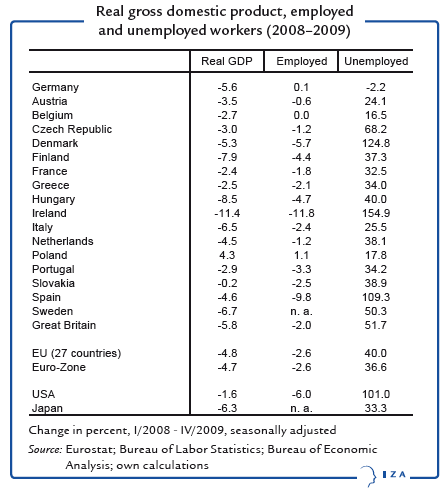
Short-time work is clearly one of the
key reasons why the Germany labor
market has remained largely unaffected
by the massive drop in production
that has hit the economy in
the spring of 2008. In other industrial
countries the impact of the crisis
was much stronger: In the United
States or Spain, for instance, unemployment
more than doubled while
the German rate remained nearly
constant.
Manufacturing particularly affected
With regard to different sectors,
there are also large differences
in the extent of short-time
work as a consequence of
the recession. While before the
economic crisis short-time work
could also be found to a considerable
degree in the construction
industry, the main emphasis
shifted to the manufacturing
sector during the course of the
crisis. In the middle of 2009, this
sector accounted for four-fifths
of short-time workers. However,
not only did f irms in manufacturing
determine the rise of
short-time work, they also governed
its fall. The development
of short-time work in other sectors
generally proceeded less
dynamically.
Nonetheless, the effect of short-time
work on this sector has
been far greater. The reason for this was
that the crisis in Germany had so far been
felt mainly in the form of a drastic decrease
in foreign demand, and the export industry
is driven in particular by firms in the
manufacturing sector. At the end of 2009,
one in ten employees subject to social security
contributions were receiving short-time
work allowance due to a reduction of
working hours in light of the economic situation.
This proportion was much lower in
every other sector.
A survey of the individual sectors reveals
a more diverse picture: short-time work
was widespread within the manufacturing
sector, in particular in engineering, metal
construction and car manufacturing – all
of which are export-oriented industries.
The same goes for textile manufacturing.
In comparison, short-time work was
used less extensively in sectors which cater
more for the domestic market. Thus,
the share of short-time work in the food
industry was a mere 0.3 percent at the
end of last year. Furthermore, not every
export-oriented industry had to extensively
adopt short-time work. One example is
the pharmaceutical industry, whose turnover
is generally less dependent on fluctuations
in the world economy: this sector’s
rate of short-time work was 0.8 percent.
|
|
|
A relatively large number of short-time
workers are to be found in areas of the
service sector in which a considerable
share of the activity is of an industrial nature
− such as the transport sector and
wholesale trade, engineering services,
advertising and temporary employment
agencies. Others sectors also include IT
services and consulting. There are, however,
sectors in the service industry in
which there is no discernible reason for
the reduction in work hours. They should
not have been affected, either directly or
indirectly, by the weak foreign demand.
Some of them, such as retail trade, hotels
and restaurants, and travel agencies, are
geared towards domestic consumption;
and domestic demand in Germany had
remained stabile despite the economic
crisis. In the construction sector, the extent
of short-time work supposedly put
down to the economic circumstances is
surprisingly high, even though production
in this sector increased significantly
from the middle of 2009 and a seasonal
short-time allowance for loss of working
hours due to weather conditions is available.
Other sectors of the economy, such
as public administration, education and
teaching, as well as health care and social
services, are by and large not sensitive to
economic circumstances – nevertheless,
short-time workers can also be found
here. It may be that these sectors have
resorted to short-time work not because
of economic circumstances but more because
of internal difficulties or structural
problems. |
|
 Prolonged short-time work
The average loss of hours for each short-time
worker has changed little since the
middle of 2009; in the past this average
had risen significantly during the
expansion phase of short-time
work. In December 2009, 60
percent of short-time workers
had working hours reduced by
up to a quarter of their contractual
obligation. As few as
one in ten had their normal
working hours reduced by
more than a half. The average
loss of hours amounted to
nearly 30 percent. Since 3 percent
of all employees subject
to social security contributions
were involved in short-time
work at the end of 2009,
the reduction of their working
hours accounts for less than
1 percent of the contractually
obligated work volume.
Whilst the total number of
short-time workers fell, the
share of employees who had experienced
a loss of hours over a
prolonged period of time rose
considerably. By the end of 2009 three
quarters of short-time workers (more
than 600,000) had been working short-time
for more than six months, 85,000
for even more than a year. The structure
of these time periods indicates that it is
leading to a structural hardening and the
establishing of a base of long-term short-time
workers. This form of long-term unemployment
is predominantly found in
manufacturing, especially in the metal
sector such as engineering and the automobile
industry.
Consequences and policy responses
Short-time work is an instrument which
can be utilized by firms to react flexibly to
changing economic circumstances. In periods
in which the economy is struggling,
the social blow of lost working hours can
be cushioned; and when the situation
improves, the necessary personnel are
immediately available. It was therefore
right to make the regulations governing
short-time work more attractive to those
affected by the crisis. In this manner, a
rise in unemployment was prevented. The
vigorous adoption of the short-time work
regulations during the crisis is proof of
the success of this policy.
It must be kept in mind, however, that
short-time work only represents an instrument
for the temporary stabilization
of the labor market: in the medium
term, negative effects can also appear.
Hence, firms could be tempted by the
possibility of longer implementation of
short-time work to neglect the necessary
efforts for improvement: in particular,
improvements in competitiveness and focusing
on new market conditions which
also require adjustments to the structure
and scope of the personnel. Therefore,
policymakers should be contemplating
an early exit out of the current rules governing
short-time work.
|
|
|
The discussion,
however, has
mainly concentrated
on conflicting suggestions:
instead of
considering possible
scenarios for
a phasing out of
short-time work,
politicians are
currently considering
the idea of
once again increasing
the eligibility
period for
the short-time
work allowance.
Furthermore,
social security
contributions
for short-time
work are not to
be paid by the
employers from
the beginning of
2011, as was planned, but will continue
to be reimbursed by the Federal Employment
Agency. Collective wage bargaining
agreements, which, in the case of short-time
work over a longer period, both
parties can bear a greater portion of the
costs than before, are possibly more efficient than these legal specifications. In
this way, incentives to refrain from making
the necessary structural adjustments
can be avoided.
|
|
|
There is the danger with all forms of
state intervention associated with cash
benefits or other instruments (such as
transfer payments, tax breaks or subsidies)
that they are open to abuse or lead
to deadweight losses. This also seems to
be the case with short-time work. Thus,
short-time workers are also to be found
in sectors not confronted with a loss of
working hours primarily due to economic
conditions. A narrower interpretation
and a consistent application of the laws,
together with tighter controls, could
overcome some shortcomings. With this
in mind, an institutionalizing of the extension
period for short-time work is unadvisable,
as misapplication can never be
completely avoided.
|
|
 Wochenbericht des DIW Berlin 16/2010, 2-13
Kurzarbeit: Nützlich in der Krise, aber nun den Ausstieg einleiten
Karl Brenke
Ulf Rinne
Klaus F. Zimmermann
|
|
| |
|
|
| |
|
|
|
|